Work / 2025
VeilA wallet that keeps your money private by default.
- Client
- Veil Labs AS
- Year
- 2025
- Role
- Product design, Identity, Prototyping
- Team
- Selma Varga, Ingrid Solberg, Jonas Haugland
The brief
Veil Labs builds a wallet for people who want to hold digital money themselves: stablecoin euros and kroner for paying friends and shops, and a little bitcoin. Its first testers liked owning their keys. They did not like what came with it. Their balance was on screen every time they paid for a coffee, every payment went to and from the same public address, and recovery meant 24 words on a sheet of paper in a drawer.
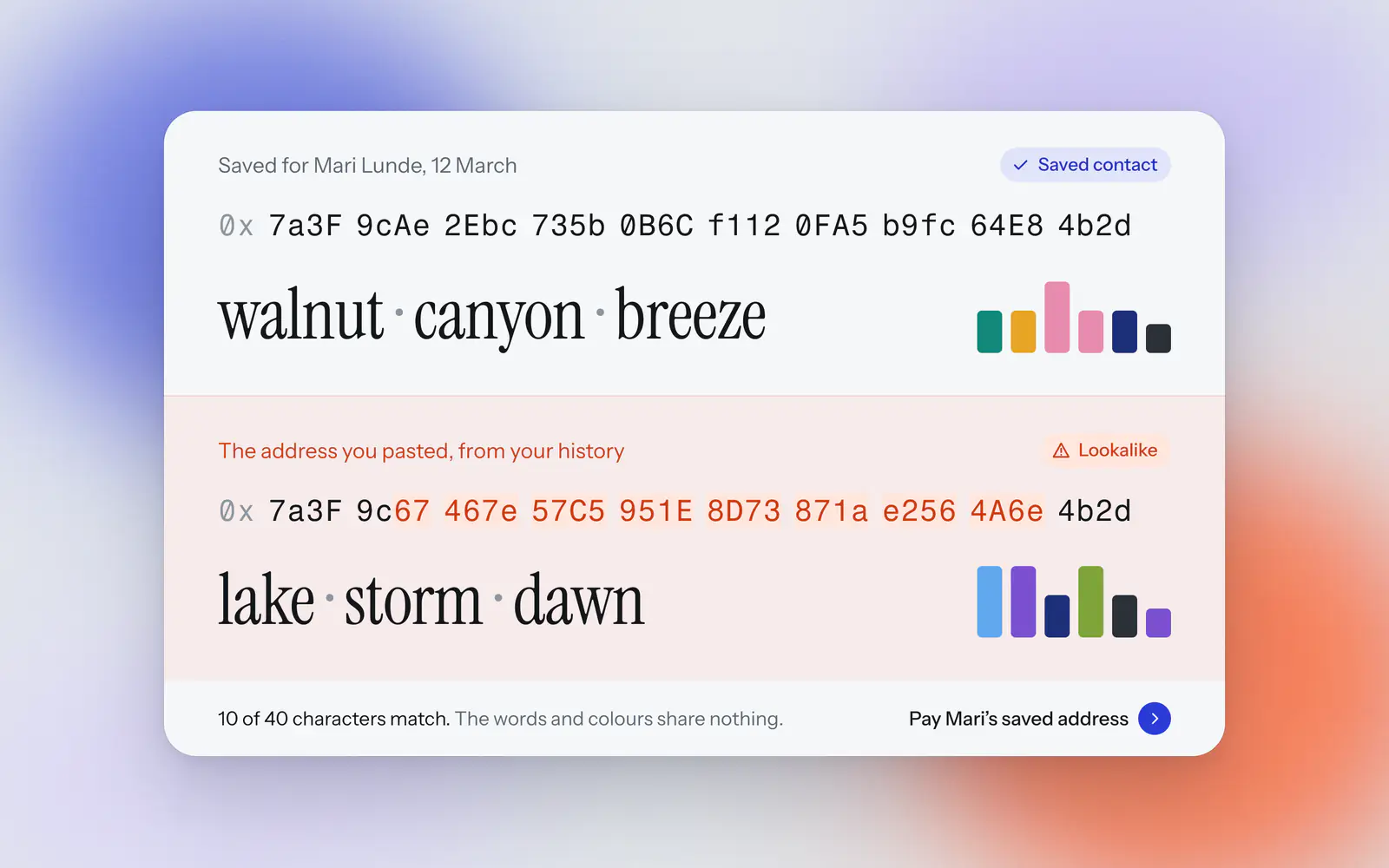
One tester had lost €1,900 the year before to address poisoning. A stranger sent him a payment of nothing from an address that began and ended like his sister’s, and a week later he copied it from his history.
The brief was a wallet that is private without asking anyone to understand privacy: safe to open on a tram, hard to pay the wrong person, and possible to recover without writing anything down.
What we decided
- 1
Hidden is the resting state
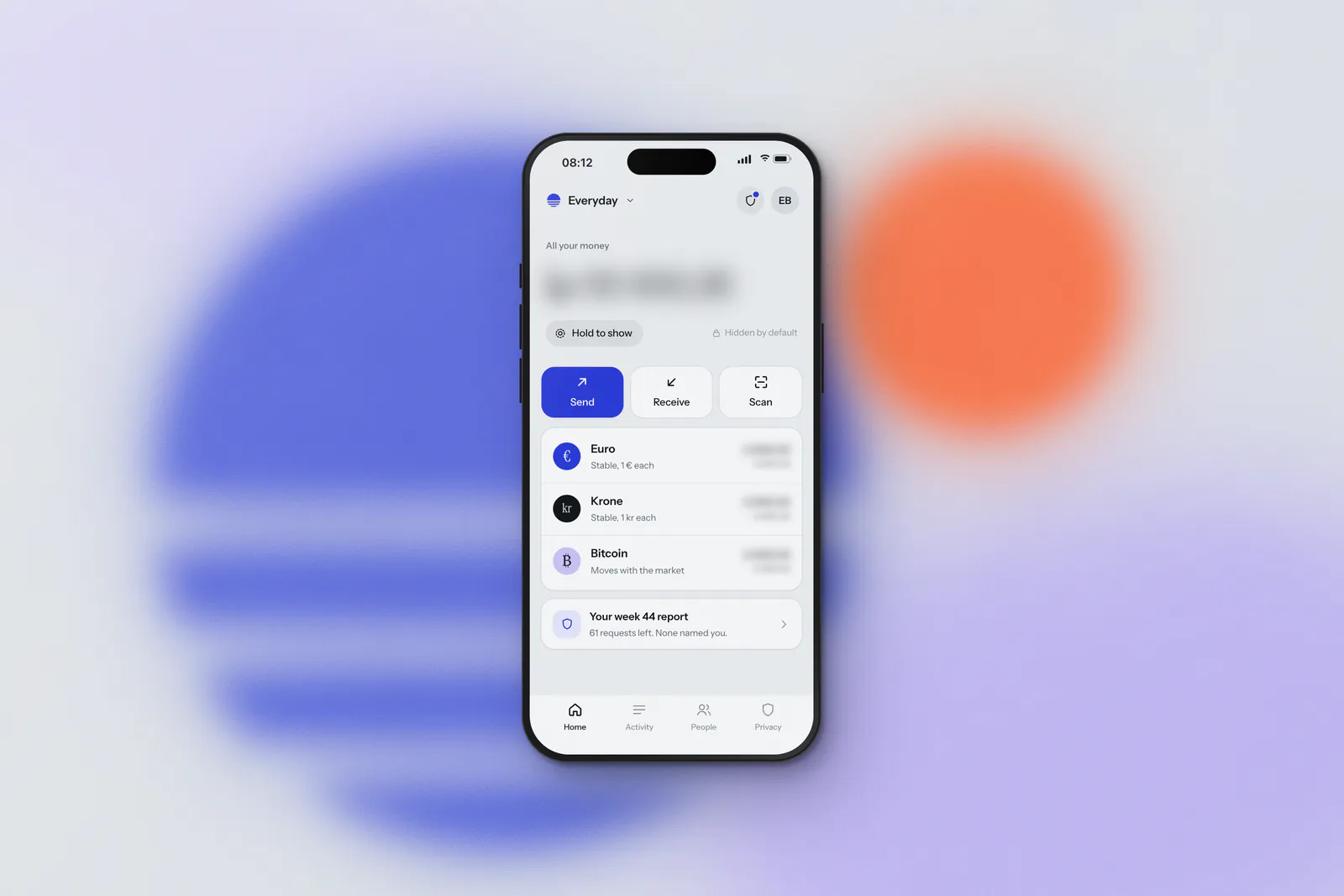
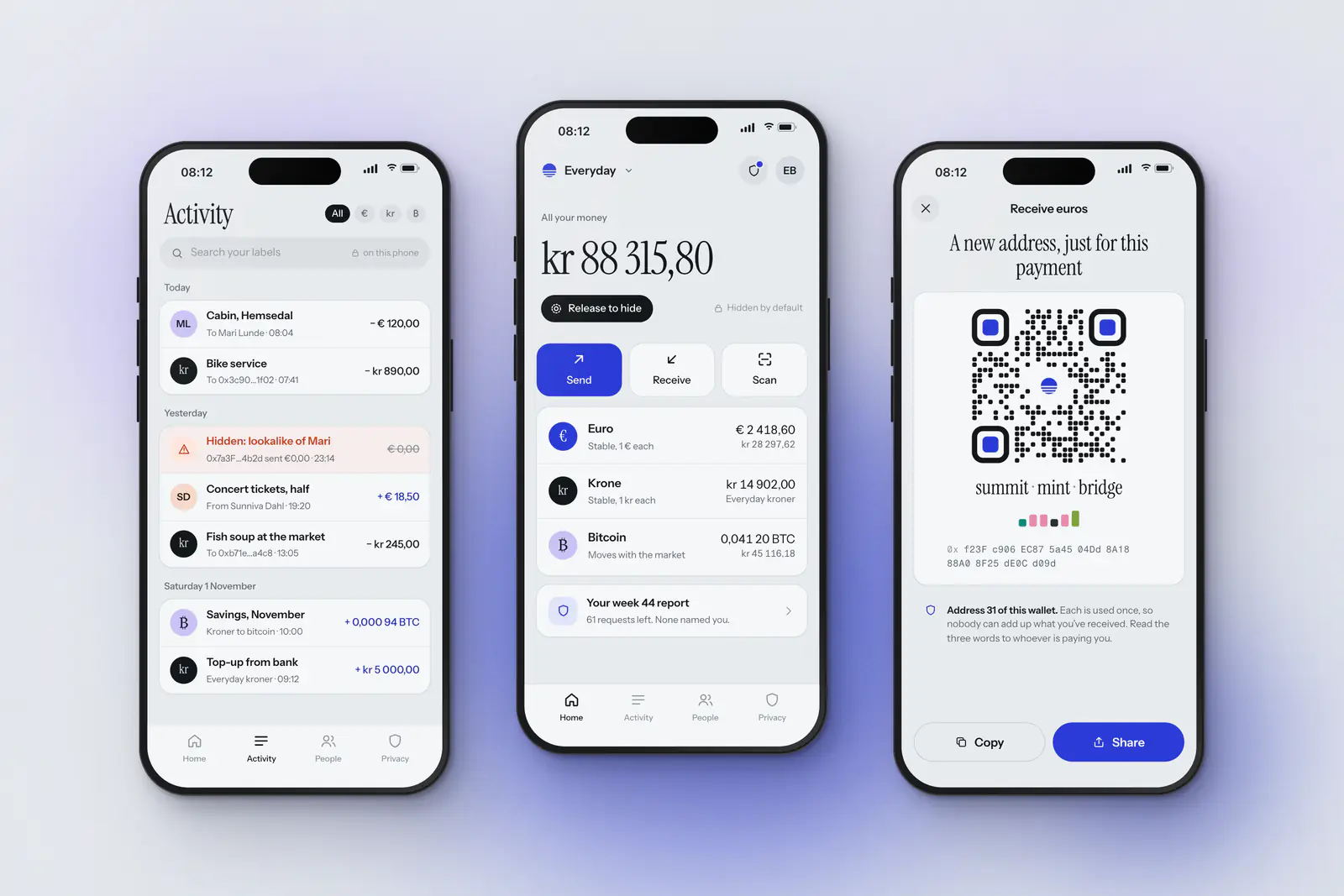
Balances show only while you press and hold. Let go and they blur again. We tested an eye toggle first, as most banking apps use, and 9 of 12 testers left it on “show” after the first day. Holding costs a second and can’t be left on. The blur is drawn at a fixed width, so it doesn’t give away how many digits you have.
- 2
Addresses you can say out loud
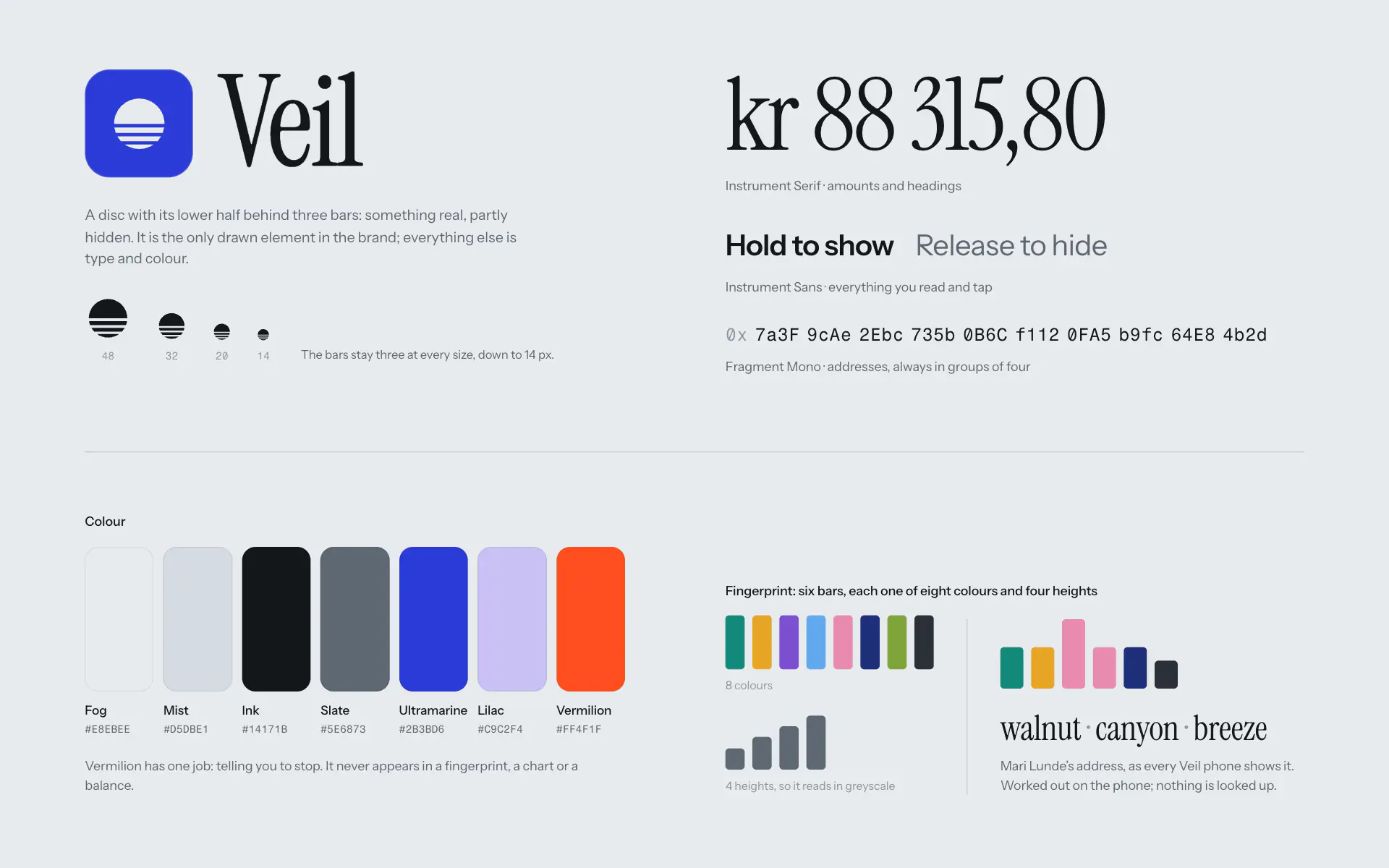
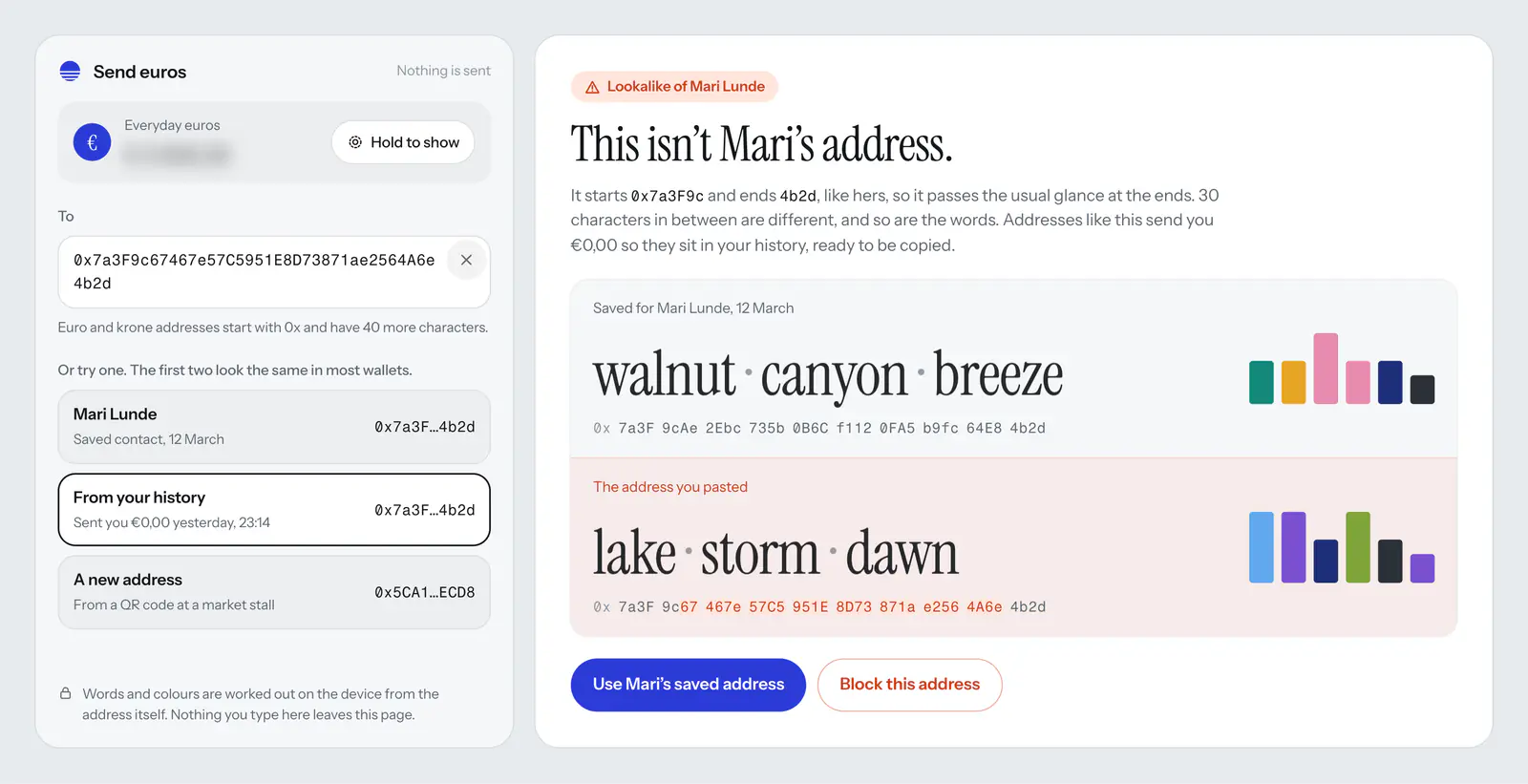
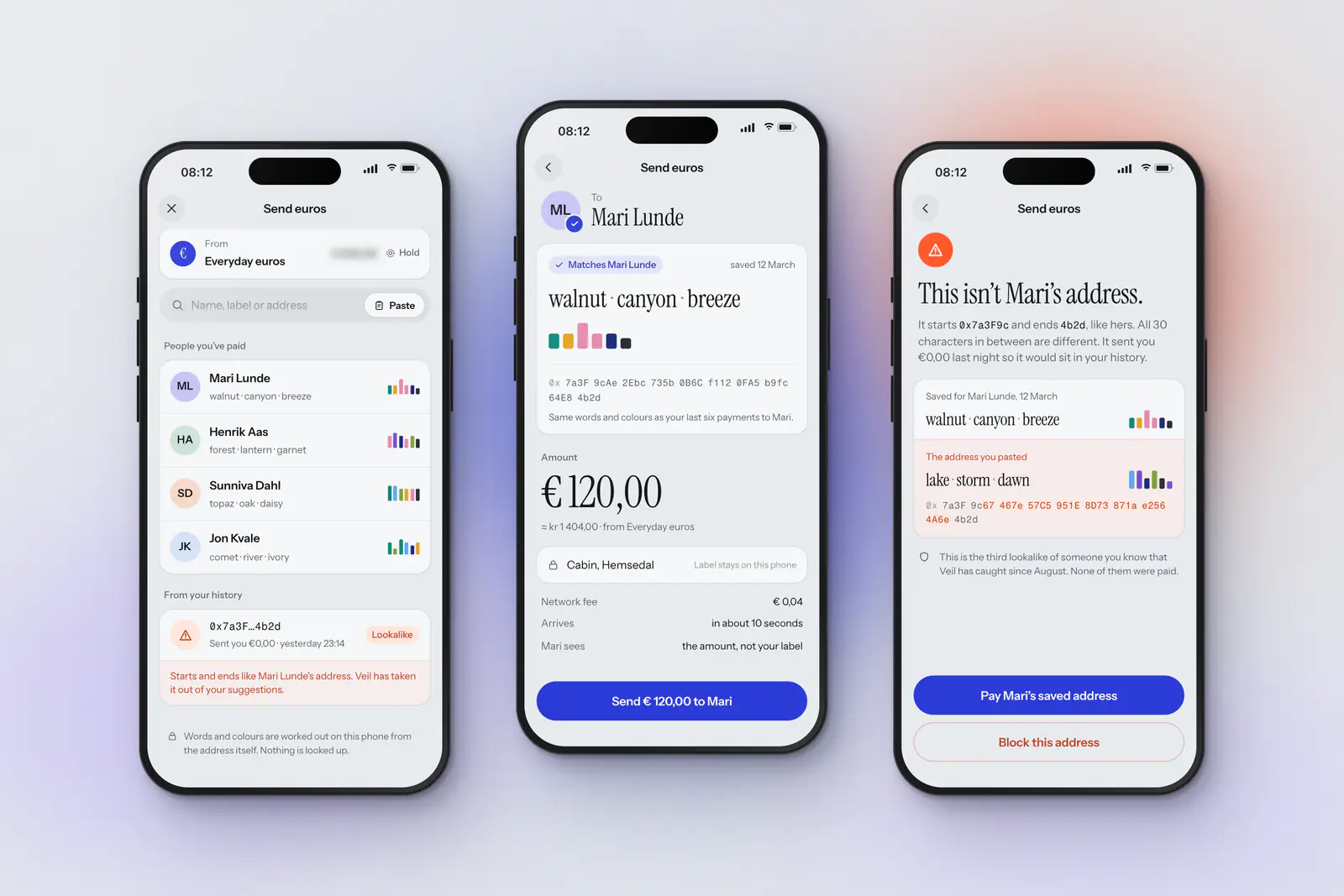
Every address is shown as three words and six coloured bars, worked out on the phone from the address itself. A poisoned address copies the first and last characters people check, but it can’t copy the words. We tried printing the full address in groups of four, then highlighting changed characters. Both still asked people to read hexadecimal carefully every time, and nobody did.
- 3
A fingerprint that works in greyscale
Each bar has one of four heights as well as one of eight colours, so the pattern still reads for colour-blind people and in the phone’s greyscale mode. We checked it with seven colour-blind testers. Vermilion never appears in a fingerprint. It has one job in the product: telling you to stop.
- 4
Show what left the phone, not a settings page
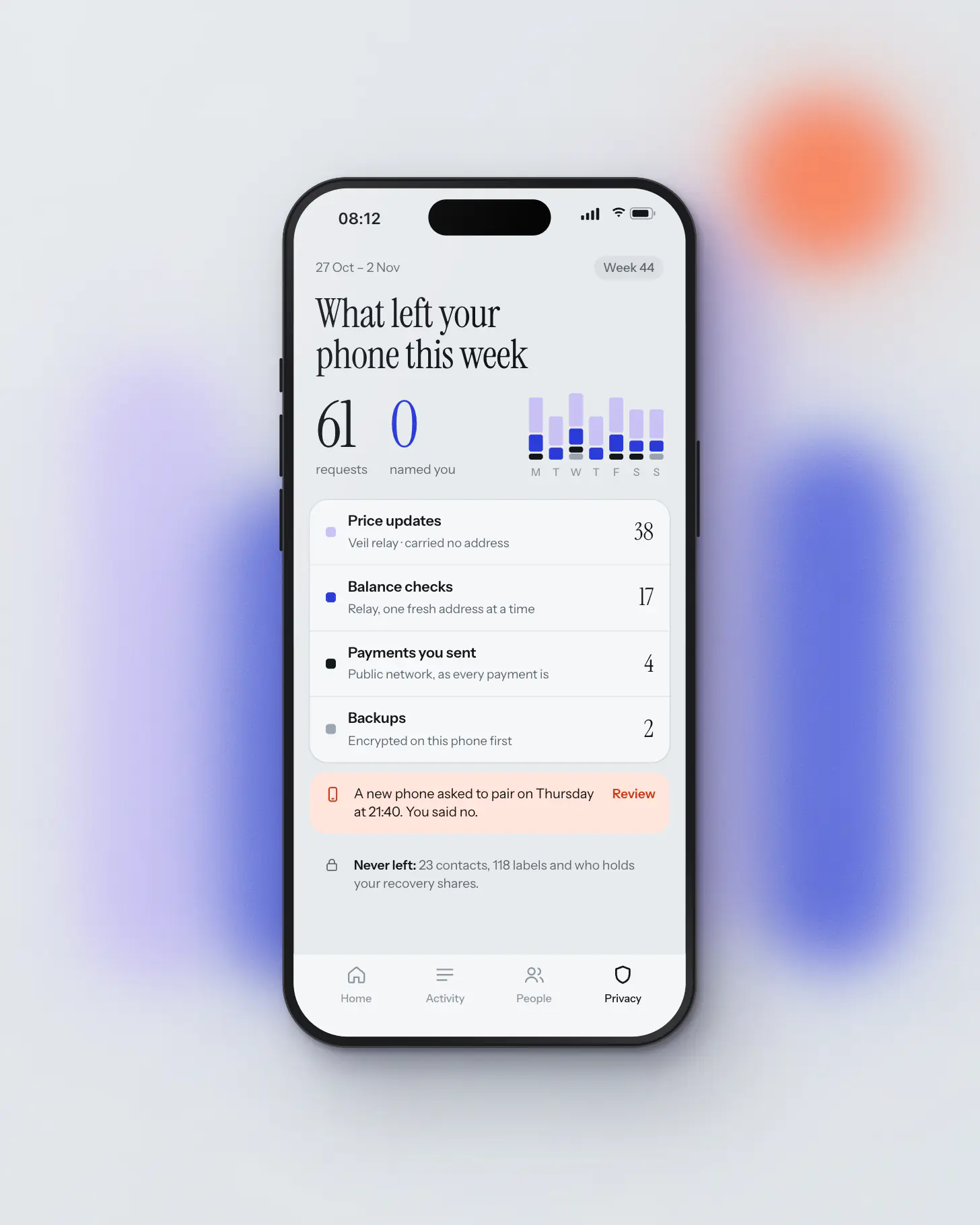
Privacy settings ask you to trust them. A weekly report shows what actually happened: every request that left the phone, where it went and what it carried. Most weeks it says the same dull thing, which is the point. When something is different, like a new phone asking to pair, it is the one line in vermilion.
- 5
Recovery held by people, not paper
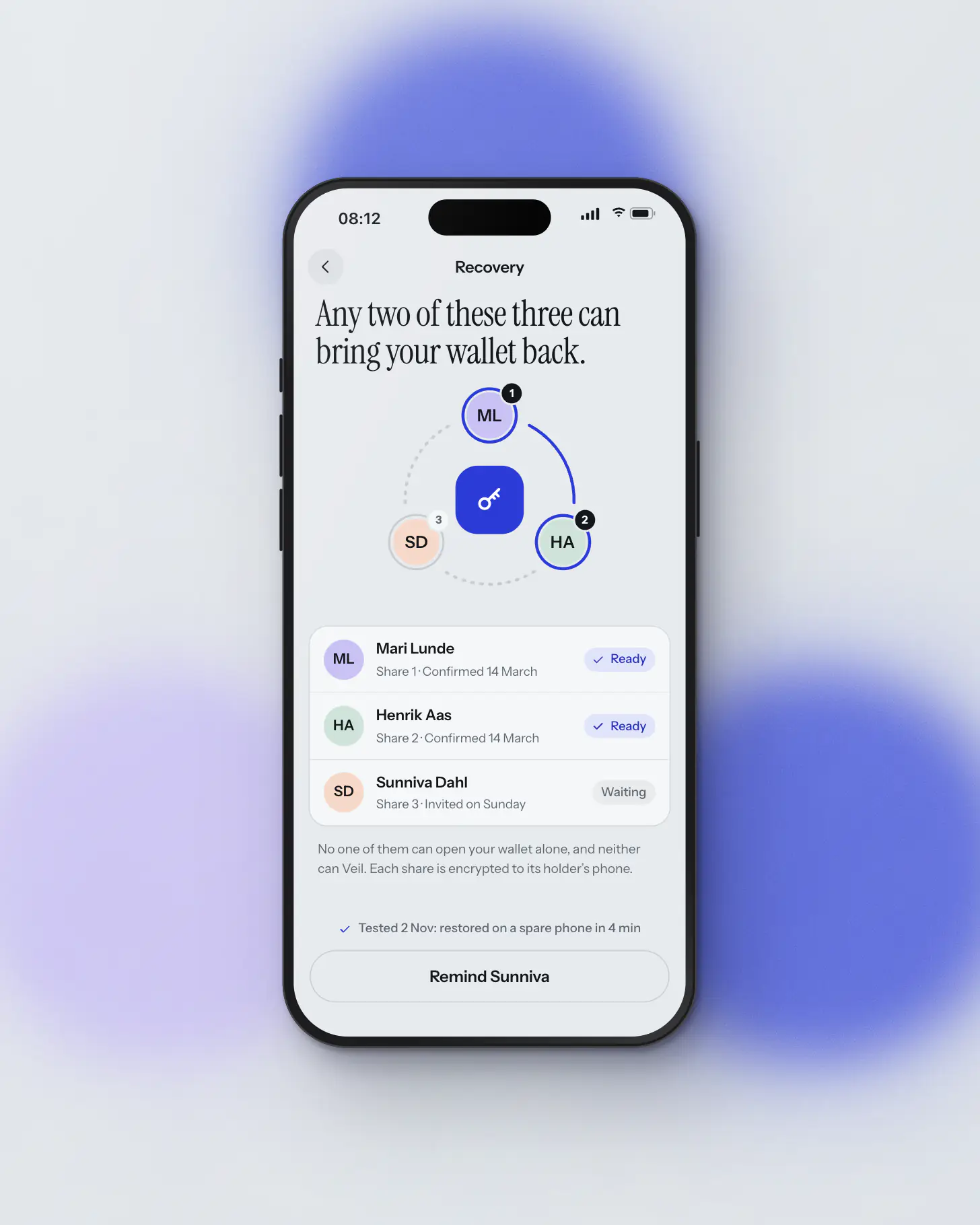
Instead of a 24-word phrase, the wallet’s key is split into three shares held by people you choose, and any two can restore it. No one of them can open it alone, and neither can Veil. We also tested two of five. Most testers couldn’t name five people without including someone they wouldn’t lend money to.
What happened
Veil launched in Norway in September 2025 and in Sweden in March 2026. It now holds 84,000 wallets, and 71% of them have recovery set up with three people.
In its first year the address check stopped 3,140 payments to lookalike addresses before they were sent. Veil knows of two that reached a poisoned address. Both were sent after the warning was dismissed, so passing it now takes two steps.
We designed the identity alongside the product, and handed over the interface library and our React prototype of the address check. Veil’s engineers built the shipped version against it.
Watching people check an address
We sat with 14 people in Bergen and Oslo while they sent money to someone they knew. Nobody read a whole address. Most checked the first four characters and the last four, which is exactly the part a poisoning attack copies.
Words were the one thing people checked without being asked. Several read them aloud to the person they were paying. So the three words became the headline of every payment, and the address moved underneath them.
“I used to check the first four and the last four characters, like everyone does. The address that nearly got me matched both. It didn’t match the words.”
- payments to lookalike addresses stopped before they were sent
- 3,140
- of wallets have recovery set up with three people
- 71%
- median hold to read a balance
- 1.4 s
- wallets in Norway and Sweden
- 84,000
Veil’s figures, September 2025 to October 2026.